The brief
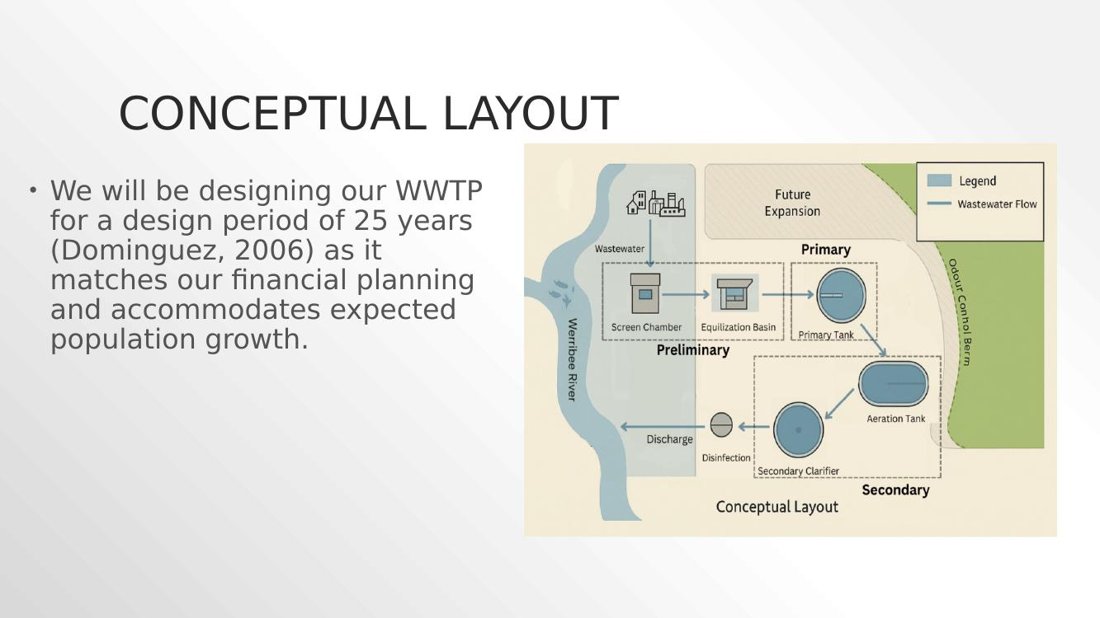
Melton City Council's Engineering Department needed a conceptual design response for a new secondary wastewater treatment plant. The scope ran the full treatment train — flow and load projections, preliminary screening, primary and secondary treatment, disinfection, and sludge handling — sized for a catchment of 340,000 population equivalent, growing at 1.3% annually over a 25-year design horizon.
Flow and load projections
Present peak flow was calculated at 292.69 ML/day, rising to 404.24 ML/day at the 25-year horizon. Present and future biological pollutant loads were calculated using the Metcalf & Eddy (2014) methodology — the standard reference text for wastewater engineering.
Preliminary treatment — screening
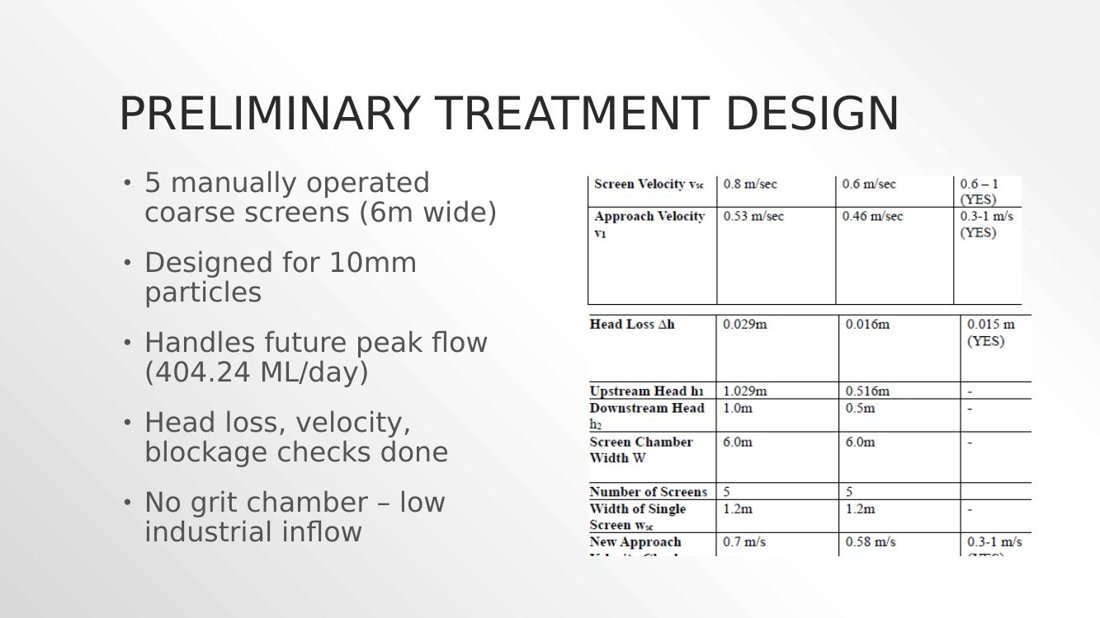
Designed a manually operated secondary coarse screen chamber: 5 screens at 1.2 m each (6 m total width), 10 mm bar spacing, set at a 30° incline. The design was verified against approach velocity (0.3–1.0 m/s), screen velocity, head loss via Bernoulli's equation, and a 50% blockage criterion — the standard check for what happens to hydraulic performance when a screen partially clogs.
Primary treatment — clarification
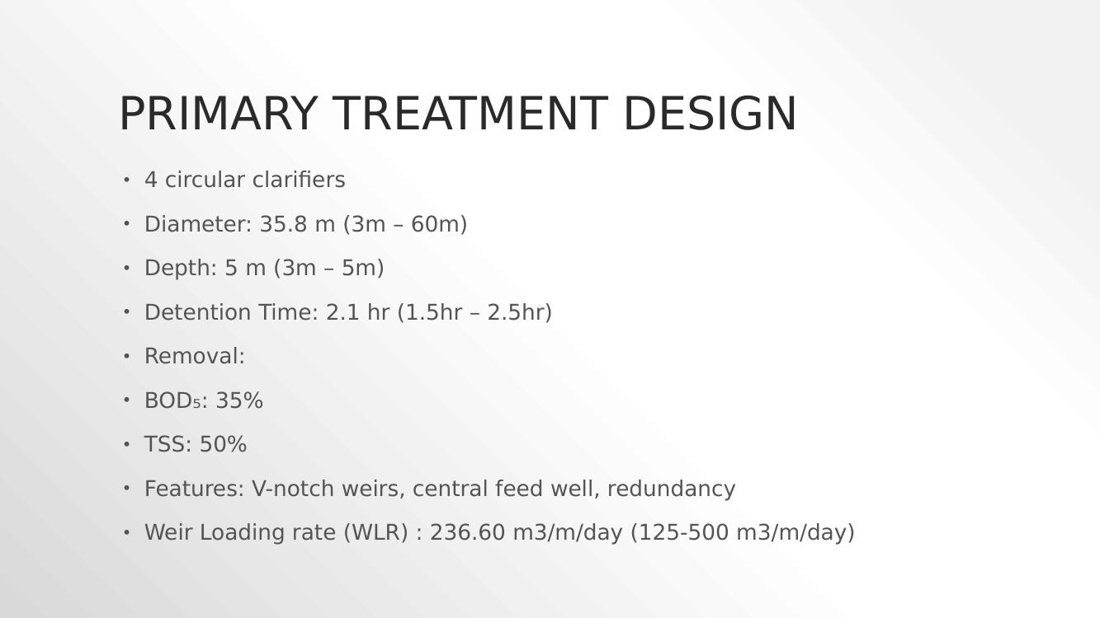
4 circular clarifiers, 35.8 m diameter × 5 m depth, 2.1 hour detention time — achieving 35% BOD5 and 50% TSS removal. Weir loading rate came out at 236.6 m³/m/day, comfortably within the acceptable 125–500 range. V-notch weirs and central feed wells were specified for redundancy.
Site selection
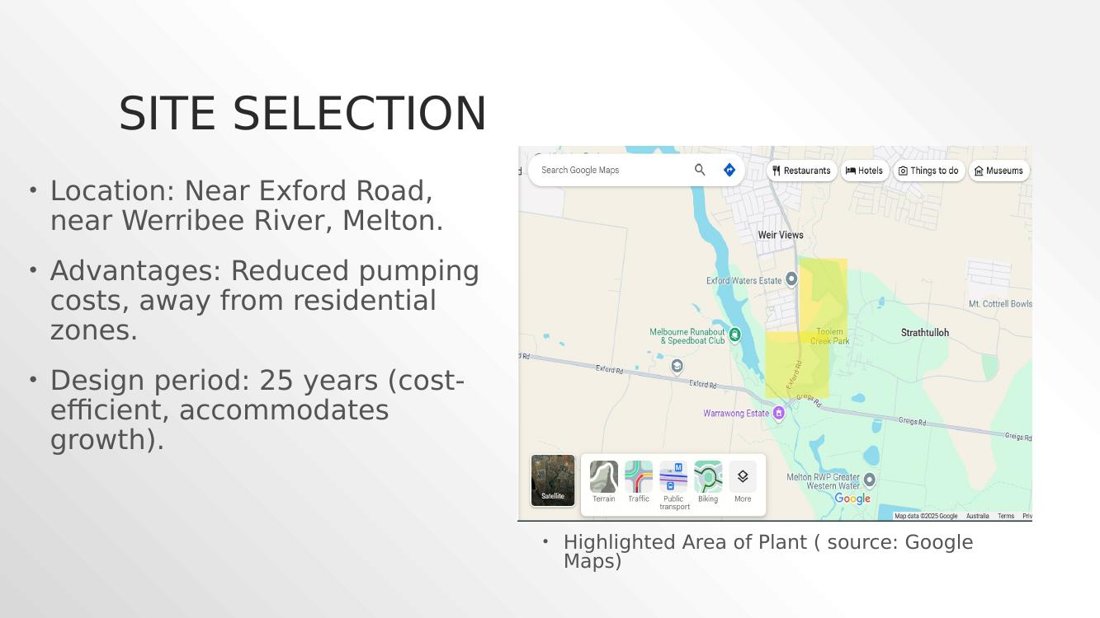
Located near Exford Road, adjacent to the Werribee River — chosen for the gravity flow advantage (lower pumping cost over the plant's life) and separation from residential zones.
Disinfection and environmental outcome
Disinfection uses sodium hypochlorite chlorination in an 8,424 m³ contact tank, targeting 0.5–1.0 mg/L residual chlorine over a 30-minute contact time. The design meets EPA Victoria discharge standards (BOD5 ≤ 20 mg/L), with dissolved oxygen recovery modelled at 10.13 km downstream. Sludge production was quantified at 1,664.84 m³/day for downstream thickening and digestion.
Tools & standards
- Manual and spreadsheet-based hydraulic calculations
- Metcalf & Eddy (2014) Wastewater Engineering methodology
- Australian Guidelines for Sewerage Systems
- Harvard referencing